
Aseptic vs Non-Aseptic Valves: How to Choose the Right Valve for Your Bulk Liquids
Key Takeaways
- Aseptic valves hold a sterile barrier so commercially sterile products can ship and store at room temperature. Non-aseptic, or hygienic, valves are built to clean easily, not to keep a product sterile.
- Decide aseptic or non-aseptic first, based on how your product stays safe, then choose the liner and the valve or fitment to match.
- For most hygienic food, beverage, chemical, and personal care liquids, the butterfly valve is the standard and Arena’s most-used outlet valve: simple, sanitary, reliable, and cost-effective across a reusable tote’s life.
- Truly aseptic products need a pre-sterilized liner with a dedicated aseptic fitment matched to the filler, which Arena’s bag-in-box system also supports.
- Seat material, valve size, and documentation should all line up with your product chemistry, cleaning method, and regulatory environment.
The difference between aseptic and non-aseptic valves comes down to a single job: holding a sterile barrier. An aseptic valve keeps a commercially sterile product sterile all the way through filling, storage, and discharge, which is what lets that product ship and sit at room temperature without spoiling. A non-aseptic valve, usually called a hygienic or sanitary valve, is built for easy cleaning and dependable food-grade service, but it does not maintain a sterile barrier. With a non-aseptic valve, the product stays safe through refrigeration, acidity, preservatives, or fast turnover instead. The practical rule is simple: choose the valve that matches how your product stays safe.
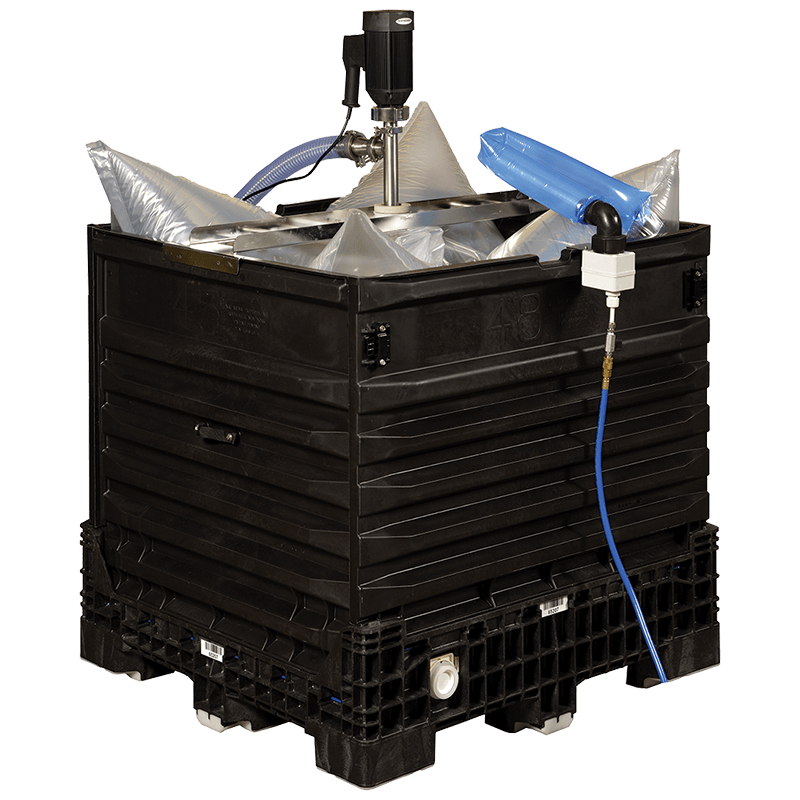
That one decision shapes the rest of your bulk-liquid setup, from the liner you order and the valve or fitment welded to it, to the cleaning your team has to validate and whether the load needs a refrigerated truck. Arena’s A330 intermediate bulk container (IBC) system is built for hot, cold, and aseptic filling and discharge, so the same tote can run very different products once it is matched to the right liner and valve. Below, we cover what each option actually does, where the butterfly valve fits (it is the valve most of our customers reach for), and how to choose the right setup for your product.
What an Aseptic Valve Does
Aseptic means free from the living microorganisms that could spoil a product or make people sick. In an aseptic operation, the product is sterilized first, often with ultra-high-temperature (UHT) heating, and is then filled into a pre-sterilized package inside a sterile zone. The package and its fitment have to hold that sterility until the product is used. The FDA’s guidance on aseptic processing makes the point plainly: commercial sterility has to be maintained not only for the product, but for the packaging equipment and the packaging material as well.
In a bag-in-box IBC, the aseptic piece is the liner and its fitment. Aseptic liners are produced in cleanrooms and sterilized with gamma irradiation, then filled and sealed without breaking that sterile barrier. Because the product never meets a contaminated surface, it can travel and sit on a shelf for months without refrigeration. That is why aseptic packaging is the default for low-acid liquids, the products that can grow dangerous bacteria if they are not sterilized. Common examples include UHT milk and cream, liquid egg, coconut water, plant-based drinks, tomato paste, and many fruit and vegetable purees.
What a Non-Aseptic (Hygienic) Valve Does
A non-aseptic valve is clean, but not sterile. Hygienic and sanitary valves are made from food-grade materials with smooth, crevice-free surfaces, so they rinse out fully during clean-in-place (CIP) or clean-out-of-place (COP) routines. The catch is that moving parts, such as the disc and stem of a butterfly valve, pass between the product and the open air, so the valve cannot guarantee a sealed sterile barrier the way an aseptic fitment can.
That is not a weakness for most products. It simply means the product relies on something other than sterility to stay safe: a cold chain, low pH, added preservatives, or being used soon after filling. Plenty of bulk liquids fit this description, including refrigerated dairy, cold-filled and hot-filled juices and sauces headed for further processing, edible oils, syrups and sweeteners, many non-hazardous industrial chemicals, and home and personal care liquids like shampoos, lotions, and detergents. For all of these, a hygienic valve is the right tool, and usually the simpler and less expensive one.
How Aseptic and Non-Aseptic Valves Differ
The two approaches differ on the points that drive a buying decision:
- Sterile barrier: an aseptic fitment holds one, while a hygienic valve does not.
- How the product stays safe: aseptic relies on sterile processing inside a sealed package, while hygienic relies on a cold chain, acidity, preservatives, or fast use.
- Shelf life and storage: aseptic products can sit at room temperature for months, while non-aseptic products are usually refrigerated or used quickly.
- Liner: aseptic uses a pre-sterilized, gamma-irradiated, cleanroom-made liner, while non-aseptic uses a standard food-grade or barrier liner.
- Connection: aseptic uses a dedicated fitment matched to a sterile filler, while non-aseptic uses a butterfly valve, cam-lock, or spigot.
- Cleaning: aseptic requires validated sterilization of the fill and discharge path, while non-aseptic uses CIP or COP, or a single-use liner changeover.
- Cost and complexity: aseptic is higher, while non-aseptic is lower.
- Typical products: aseptic suits UHT dairy, liquid egg, juices, purees, and tomato paste, while non-aseptic suits refrigerated or hot-fill foods, oils, chemicals, and personal care liquids.
Why the Butterfly Valve Is Arena’s Go-To
For the large majority of hygienic, non-aseptic bulk-liquid work, the butterfly valve is the standard outlet, and it is the valve Arena fits and recommends most often on the A330 system. A few reasons it earns that spot:
- Simple quarter-turn operation. A 90-degree turn of the handle takes the valve from fully open to fully shut, so operators can work quickly and can see at a glance whether the valve is open or closed.
- Few parts to fail. A butterfly valve is essentially a disc, a stem, and a seat. Less hardware means less wear, less maintenance, and fewer leak points over a tote’s working life.
- Dependable, drip-tight shutoff. The seat seals around the disc to close cleanly on pourable liquids, which keeps discharge tidy and reduces product loss.
- Sanitary seat options. Seats in EPDM, PTFE, or silicone can be matched to the product and the cleaning chemistry, and all of them stand up to CIP and COP routines.
- Compact and light. Its short body adds little length or weight to the tote outlet, which matters when totes are stacked, collapsed, and handled by a single operator.
- Controllable flow. The disc throttles smoothly, so an operator can set a steady discharge rate instead of dealing with an all-or-nothing valve.
- Easy, tool-free connections. Butterfly valves pair with standard 2-inch and 3-inch outlets and accept a cam-lock or hose fitting downstream for fast hookups during frequent container swaps.
- Low cost over a reusable life. A modest upfront price and low upkeep keep the total cost down across the ten-year service life of an Arena tote.
There is one fair trade-off worth naming. Because the disc sits in the flow path, very thick or particle-heavy products can move better through a full-bore valve. For the clean, pourable liquids that make up most food, beverage, chemical, and personal care applications, though, the butterfly valve is hard to beat on hygiene, simplicity, and cost.
When You Need an Aseptic Fitment Instead
It is worth being clear about one thing: aseptic is not a butterfly valve. If your product is aseptically processed and has to stay commercially sterile, you do not reach for a standard valve at all. You use a pre-sterilized liner with a dedicated aseptic fitment that is matched to your filling line and designed to connect and disconnect without breaking the sterile barrier. Arena’s bag-in-box system supports aseptic filling and discharge, and our team specs the fitment to your filler. The order of operations is what matters: choose the process first, aseptic or not, then the liner, then the valve or fitment that fits.
Choosing the Right Valve for Your Application
Working through a few questions usually points to the right answer:
- Does the product have to stay commercially sterile and shelf-stable at room temperature? If yes, you are in aseptic territory and need a sterile liner and fitment.
- Is it a low-acid product, with a pH above 4.6? Low-acid liquids generally need sterile processing and an aseptic package to ship without refrigeration.
- Do you have a cold chain, or does the product rely on acidity or preservatives? If so, a hygienic butterfly-valve setup is usually the simpler and cheaper fit.
- How thick is the product, and does it carry pulp or particles? Thin, clean liquids suit a butterfly valve, while very heavy or chunky products may call for a full-bore option.
- How often do you switch products in the same tote? Frequent changeovers favor single-use liners and quick cam-lock connections.
- What will your auditor and customers expect? Match seat materials, fitments, and documentation to your regulatory and quality requirements.
Arena can match the right liquid liner and valve or fitment to your product, your filling line, and your compliance requirements. Contact us today to request a quote or speak with an expert.